
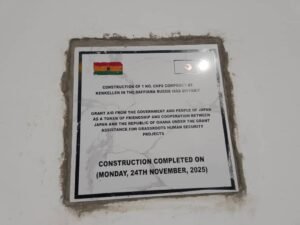
The Government of Japan, through the Embassy’s Grant Assistance for Grassroots Human Security Projects (GGHSP), has funded and commissioned a CHPS Compound valued at US$69,847, equivalent to GH₵801,245, for the people of the Kenkellen community and its surrounding areas in the Daffiama Bussie Issah District of the Upper West Region of Ghana.
The facility forms part of broader efforts to enhance access to healthcare in rural communities and to provide accommodation for health workers, ensuring reliable 24-hour service delivery. This modern health facility, along with others supported by Japan, underscores the partnership between Japan and Ghana in promoting grassroots human security through targeted interventions in health and related sectors.
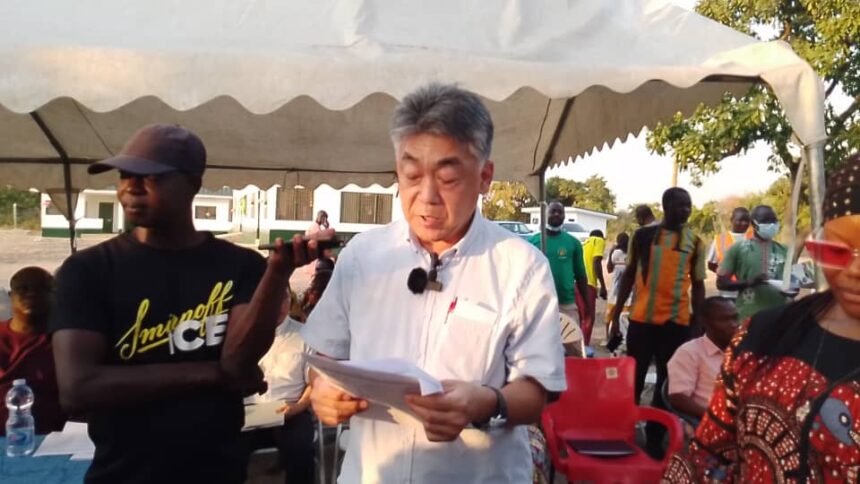
Speaking at the community durbar before the commissioning, the Deputy Head of Mission, Mr. Naoki Mitori—representing the Ambassador of Japan to Ghana, Mr. Hiroshi Yoshimoto—described the project as a continuation of the longstanding relationship between Japan and Ghana, which dates back to 1927 during the Gold Coast era. He reaffirmed Japan’s commitment to supporting Ghana’s primary healthcare system, adding that the enduring friendship between the two countries has facilitated numerous forms of assistance, including road and bridge construction, school buildings, electrification projects, human resource development, and health infrastructure such as CHPS compounds.
On behalf of the Ambassador, Mr. Mitori expressed his delight in commissioning the project and extended gratitude to the Daffiama Bussie Issah District Assembly, the Ghana Health Service, and the chiefs and people of the Kenkellen community for their cooperation in completing the facility. He further encouraged health workers and community stakeholders to safeguard the building to ensure its sustainability for future generations.
The District Chief Executive for the Daffiama Bussie Issah District Assembly, Hon. James Wor, conveyed appreciation to the Government of Japan and the GGHSP for supporting the provision of this essential facility in a community with significant healthcare needs. He also acknowledged the efforts of his predecessor, Hon. Nadi Imoro Sanda, for initiating and facilitating the project.
Hon. Wor appealed to the Japanese Ambassador for additional support in the form of cold-chain equipment to enable the district and its health workers to store essential medicines, thereby improving the quality of healthcare services delivered across communities within the district.
By Romanus Bombe Kyi-Era