
Accra, March 26, 2026
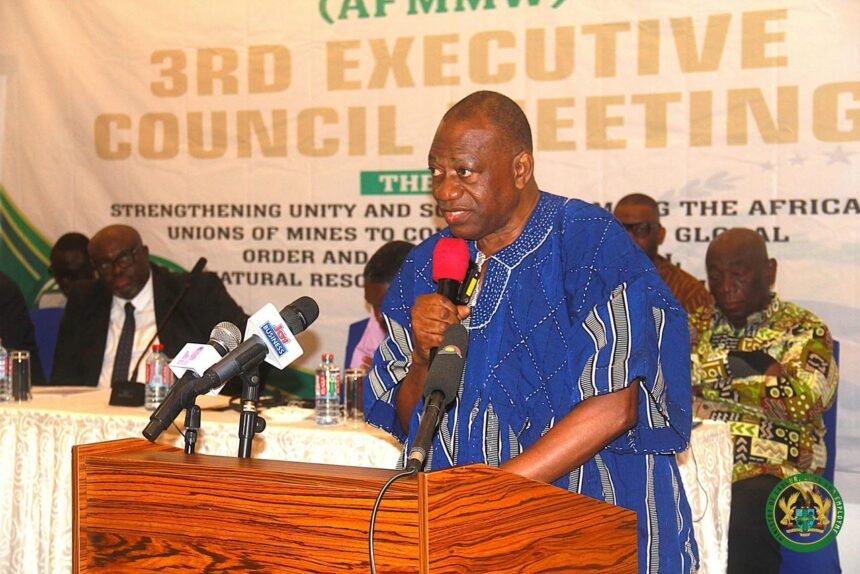
Africa must take decisive ownership and control of its natural resources and critical minerals to meaningfully improve the livelihoods of its people, the Minister for Labour, Jobs and Employment, Dr. Abdul-Rashid Hassan Pelpuo, has said.
He stressed that this ambition can only be realised through deeper regional integration, anchored on the African Continental Free Trade Area (AfCFTA), which he described as pivotal to expanding intra-African trade and accelerating industrialisation. According to him, increased trade within the continent will reduce reliance on external markets while unlocking opportunities for value addition.
“By trading more among ourselves, we reduce dependency on external markets. We must invest in processing and manufacturing to capture greater value from our resources, create jobs, and stimulate our economies,” Dr. Pelpuo emphasised.
The Minister made these remarks at the Executive Council Meeting of the African Federation of Miners and Mineral Wealth (AFMMW), a three-day gathering of trade union leaders from across the continent. He observed that despite Africa’s vast reserves of resources – including cobalt, lithium, gold and oil – the continent remains at the centre of a renewed global contest for control and influence.
“Our collective responsibility is to ensure that these resources benefit our people, drive sustainable development, and strengthen Africa’s position in the global economy,” he stated.
Dr. Pelpuo further noted that Africa’s mineral wealth places it at the heart of the global energy transition and technological advancement. With over 30 per cent of the world’s critical green minerals – and countries such as the Democratic Republic of Congo leading in cobalt production – he underscored the urgency for African nations to act in unity. He added that the African Union’s vision of an integrated, prosperous and peaceful continent has never been more relevant.
Also addressing the meeting, the General Secretary of the Socialist Movement of Ghana and Managing Editor of the Insight newspaper, Mr. Kwesi Pratt Jr., called on the federation to confront the growing challenge of casualisation in the mining sector. He described the trend, prevalent in countries such as Ghana, South Africa, Tanzania, Zambia and the Democratic Republic of Congo, as a deliberate strategy to weaken organised labour rather than a mere management issue.
The President of AFMMW, Mr. Joseph Chewe, highlighted intensifying global competition for Africa’s critical minerals, noting that major powers, including China and the United States, are actively seeking access through investments and bilateral agreements. He urged African mining unions to move beyond rhetoric and embrace a unified, coordinated front.
“Unity among African mining unions must transcend declarations and translate into concrete, coordinated action. We must speak with one voice on key issues, including labour standards and collective bargaining,” he said.
For his part, the General Secretary of the Ghana Mineworkers’ Union (GMWU), Mr. Abdul-Moomin Gbena, noted that the union was established to foster solidarity among mineworkers across the continent, protect their rights, and promote occupational health and safety.
In a solidarity message, the Secretary-General of the Trades Union Congress (TUC), Mr. Joshua Ansah, lamented that despite Africa’s rich natural endowment, many mining communities continue to endure harsh living conditions. He stressed the urgent need for reforms to ensure that the continent’s resource wealth translates into real and lasting benefits for its people.